 Startups
How IGA Is Equipping Nigerian Youth With Tech, Business, and Life Skills for Global Relevance
Oyedele Damilare | June 30, 2026

Oyedele Damilare
ADMIN
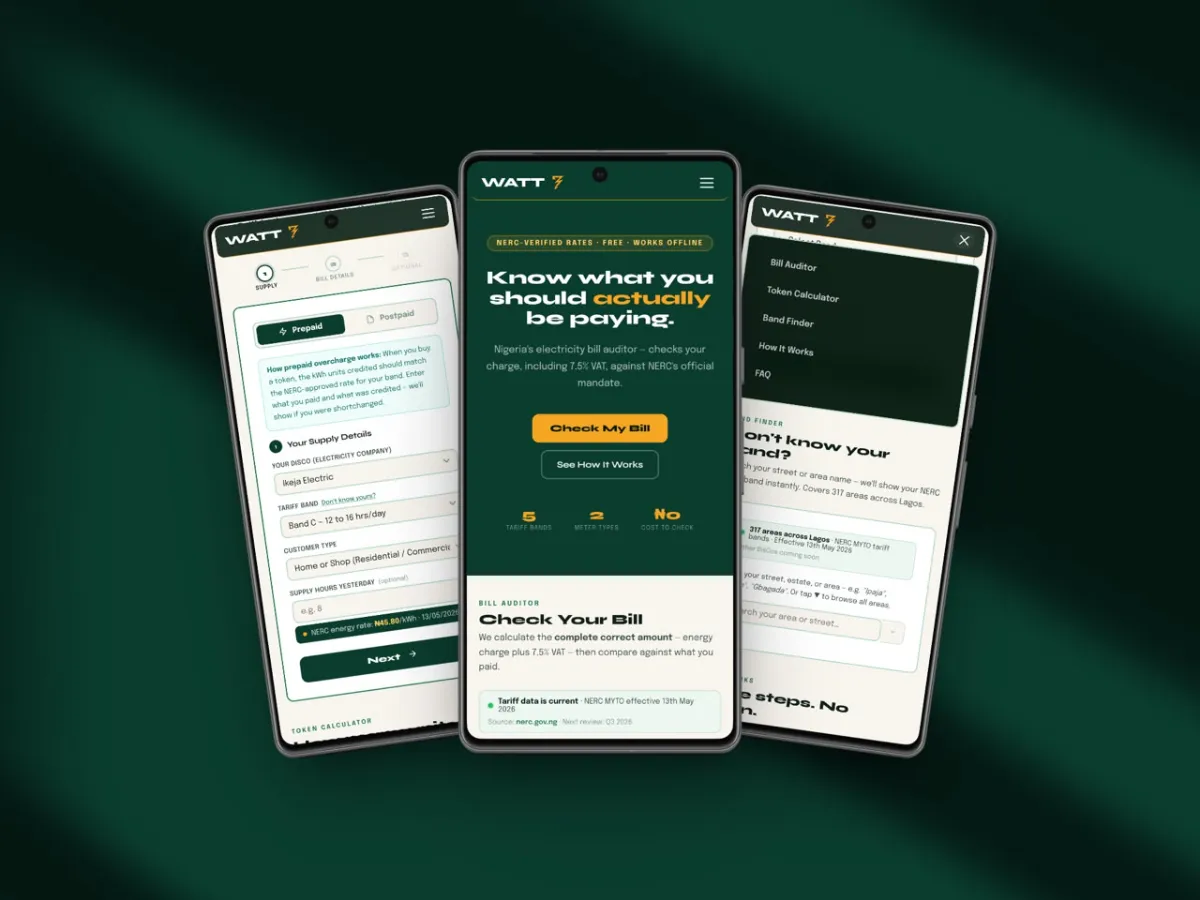
For millions of Nigerian electricity consumers, the monthly bill arrives as a number with little explanation behind it. Few have ever read a Nigerian Electricity Regulatory Commission (NERC) tariff order, and the underlying framework, known as the Multi-Year Tariff Order (MYTO), spans five service bands and multiple customer categories. That complexity, paired with the widespread practice of multi-tenant buildings distorting individual billing information, has created a persistent information gap between distribution companies (DisCos) and the customers they serve. CheckWatt Technologies Ltd is attempting to close that gap with WATT?, a tool it describes as Nigeria's first free, offline-first electricity bill auditor.
The consequences of that information gap are not abstract. High volumes of billing disputes strain DisCo customer service desks and erode consumer trust in utility providers, a dynamic that has become a recurring friction point across Nigeria's power sector.
WATT? was built to function as a translation layer between the technical math utilities use to calculate charges and the everyday consumer trying to understand a bill. Users input their prepaid tokens or postpaid bills, and the platform's offline-first engine checks the amount against NERC's approved MYTO rates, accounting for the mandatory 7.5% VAT applied to electricity charges. An Area Band Finder feature is designed to prevent misclassification of customers into the wrong service band, one of the more common sources of disputed charges. When the platform detects overcharging, it automatically generates formally worded dispute letters that users can send directly to their DisCo via WhatsApp.
Since its beta launch, the platform has surpassed 1,000 active users without any paid advertising, growth the company attributes to organic word-of-mouth adoption. Its Area Band Finder has mapped 317 specific areas across Lagos. CheckWatt Technologies Ltd has since been formally incorporated, and the company says its data-driven approach to utility billing has drawn attention from regulators, including public engagement from EKEDC's official channels and NERC leadership. The company is also entering a business-to-business pipeline, licensing its calculation engine via an API to other SME platforms operating in adjacent spaces.
The billing transparency problem CheckWatt is addressing sits at the intersection of consumer protection and regulatory enforcement, two areas where Nigeria's electricity sector has faced persistent scrutiny since the partial privatization of distribution companies over a decade ago. Startups building consumer-facing tools on top of regulatory frameworks like MYTO represent a growing trend within Nigeria's broader technology ecosystem, where founders are increasingly using software to interpret and enforce existing public-sector rules rather than waiting for institutional reform. For Ogun State and the wider Nigerian tech landscape, CheckWatt's trajectory reflects how localized consumer-protection tooling can scale into infrastructure that regulators and utilities themselves engage with.
Looking ahead, CheckWatt says it intends to move beyond its consumer-facing B2C product into B2B enterprise infrastructure. The company's stated plan involves aggregating localized, anonymized audit data to give utility partners and regulators predictive heat maps of grid friction and collection losses, with the broader ambition of becoming a national standard for utility billing transparency in Nigeria. Whether that vision materializes will depend on continued adoption and the willingness of DisCos and regulators to integrate third-party transparency tools into their own processes, a dynamic worth watching as the company moves further into its B2B pipeline.
Startups Startups
 Startups